CSC300: Service Learning Assignment: Jane’s Walk
By Matej Masiar
Jane’s Walk is a non-profit organization that was started in 2007 to commemorate the work of Jane Jacob’s and spread awareness of her ideas on urban planning. They decided on a simple concept that would prove to be an international hit – free neighborhood walking tours led by local volunteers. Not only did these tours provide a voice for people to discuss issues affecting their neighborhoods, it also became a great way to get involved in the community and to meet new people. The idea quickly took off, and the rest as they say, is history!
Interestingly enough, despite the walk’s gaining international traction and a loyal following; few people knew who Jane Jacob’s was or her history. Jane had no formal education in city planning, but her 1961 book “The Death and Life of Great American Cities” introduced ground-breaking ideas about how cities and neighborhoods function. She had several notable insights into why certain neighborhoods prosper and others fail and what unique qualities truly make them desirable.
It is this book that was the focus of study for the group that we were working with from Professor Matt Price’s history course. The primary focus of the project was to raise awareness about Jane Jacob’s and her book. The team from Dr. Price’s class was asked to create a “micro-site” that would be a part of the primary janeswalk.net web site. However, many of them did not have technical backgrounds and were not familiar with how to build an effective web site. Julia Bennett, for example, had a background in film and was a successful journalist in her career. Martin Gould was involved in the book publishing industry for many years, but was looking for a career change, and Jason Voulgaris was a History student wrapping up his major. Hence, the team asked for our guidance, advice, and help with the implementation of the site.
Initial Meeting - March 13th:
On my initial meeting with Jason and Julia at the Toronto Reference Library, we spent approximately three hours discussing various facets of web development, web architecture, and the basic techniques and building blocks of web sites. Julia in particular wanted to get a more “holistic” understanding of how the Internet worked and what the key building blocks were in getting a web site up and running. Hence, we took a step back and I spent some time explaining the fundamentals of web development and internet architecture.
Initially I had planned to give a quick overview of the key technologies, but Jason and Julia were rather curious about many of the technical details that go into creating and maintain a web site. Hence, I walked them through the process of registering a domain with a registrar like GoDaddy or Network Solutions, the process of settings up a web host, what DNS is, what whois services are and how they can help you determine where a site is hosted and how end-user browsers like Firefox or Chrome interact with web servers.
The conversation then progressed to the differences between server side and client side code in the web realm. I explained to Julia that there are a number of different backend technologies such as PHP or ASP.net or JSP that allow you to create dynamic web applications that pull information from databases such as MySQL or SQL server, in essence providing end-users with a more interactive and personalized web experience. Then I explained to her that fundamentally all these different backend technologies produce the same type of front-end code that is sent to the user, namely HTML, CSS and JavaScript.
The conversation then delved into how HTML is essentially a markup language that defined certain content types, while CSS lets you add formatting and design to your raw HTML to make a site more visually appealing. Finally, JavaScript is instrumental in created dynamic content like animations or AJAX calls that allow web applications to perform in a similar manner to traditional application. Although this took a significant amount of time, Jason and Julia really seemed to appreciate the understanding they gained from the overview. As Julia mentioned in one e-mail, she remarked “Hi Team, We had a great meeting with Matt and discovered using some site content that we don't have quite what we need to build yet. We're continuing to write the content and also hope to meet our service clients in next couple of days to get more access in the way of a demo site”
We wrapped up the meeting with some exploration of the Expression Engine CMS platform that is currently used on the janeswalk.net web site. The site administrators had setup a “sandbox” for the team to test and publish new pages in, however, it was not properly configured and many features like the ability to upload images and videos were not enabled. Since we were not able to do much with the way the system was configured, I suggested we wrap up and schedule a meeting with the Jane’s walk staff to iron out the quirks and get the sandbox to a state where we could actually preview our work in the context of the main site.
Second Meeting – March 16th:
Our second meeting was scheduled with Emmy Pantin of Jane’s Walk at 215 Spadina Avenue to go over the issues we unearthed with CMS system configuration. Fortunately the meeting went well and we were able to make some progress with Expression Engine. After some configuration changes we discovered how to view and publish our changes and how to use the primary Jane’s walk template to build our site around. The technical team also promised to work on the issue of upload photo. Julia and Jason also made some good progress on content for the site. We planned to regroup against shortly to discuss a draft for a site architecture for the micro-site and the key content pieces that would need to be developed.
Third Meeting – March 31st:
During our third meeting, the whole team was able to re-group to share the progress that they made. Jason and Julia showed off some of the preliminary pages they were able to put together, which were comprised primarily of images and text and we learned the URL for the pages was to be janeswalk.net/history/pages.
Perhaps the most important thing we achieved at this meeting was creating a site architecture with a proper hierarchy of pages that would be featured on the micro-site.
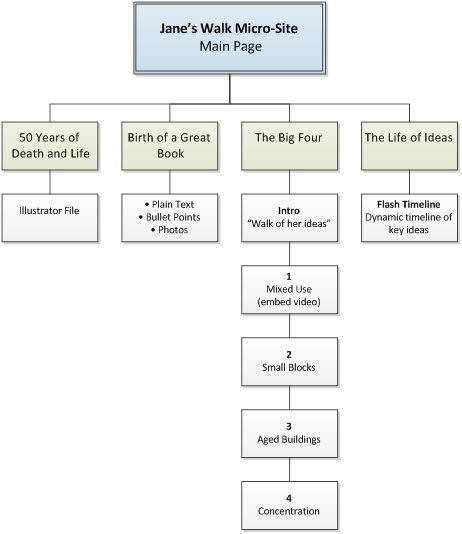
This allowed us to divide up responsibilities based on our respective skill-sets for the final deliverables required to complete the site in time for the May 7th launch.
This experience actually opened my eyes to the fact that the digital divide is prevalent across many different age and social groups. In our instance, everyone involved in the project had above average academic or professional credentials, however, they generally did not have a need to perform complex technical work in their past professions or academic work. Nonetheless, everyone in the group had a certain basic degree of technically literacy which made explaining the key concepts of what needed to be done to implement the site easier. Beyond that, however, age or educational level did not seem to matter when it came to technically literacy. Everyone involved on the team was learning as they went along and all were equally fascinated with picking up new technically concepts that would be useful to them in future endeavors.
After our last meeting, it was decided that I would undertake the responsibility of creating an interactive “walk-through” that featured the four key tenants of Jane’s theories on community sustainability. Primarily the idea of Mixed Use buildings, meaning that people live where they shop and everything is at hand, which is contradictory to the urban planning in many suburban neighborhoods. Next is the idea of “small blocks”, meaning that smaller blocks allow better interconnects and encourage people to walk more. Aged buildings offer character and history to a neighborhood and are therefore appealing to residents. Finally, the concept of “concentration” where people live in mixed density dwelling in the same area. The idea was to show these concepts in an appealing visual manner akin to a winding road, with each concept being at different apexes of the curves on the road. The end user would hover over the key areas and be presented with examples of these concepts in Toronto neighborhoods. For example, a YouTube video would pop-up with a time lapse of a few blocks in the Annex to show how people move about and interact. Other pop-ups would feature images or more descriptive text about key concepts. While this work is still ongoing due to missing content from members of the group, I was able to accomplish the base design and code for it and it should be ready for the launch of the site.
Our team was able to divide up the work to be done by focusing on everyone’s strengths and skill-sets. For example, I was able to use my graphic design and web development skills to create an interactive “walk” oh Jane’s key tenants. Evangelos was able to use his knowledge of ActionScript and Flash programming to create a dynamic auto-scrolling timeline that would load data from an XML file that was easily editable. Martin was able to design a main banner and menu for the micro-site, while Julia used her video editing skills to create time-lapse video of Toronto neighborhoods and take images of key concepts that were to be featured from the book. Martin, Julia, and Jason all worked on content for the various pages as they knew Jane’s book best and what ideas they wanted to feature. Once they complete their draft content, I will further assist with formatting and page layout for the final site. Ultimately I felt that we all made use of our strengths to complete the task required in the limited time we had.